
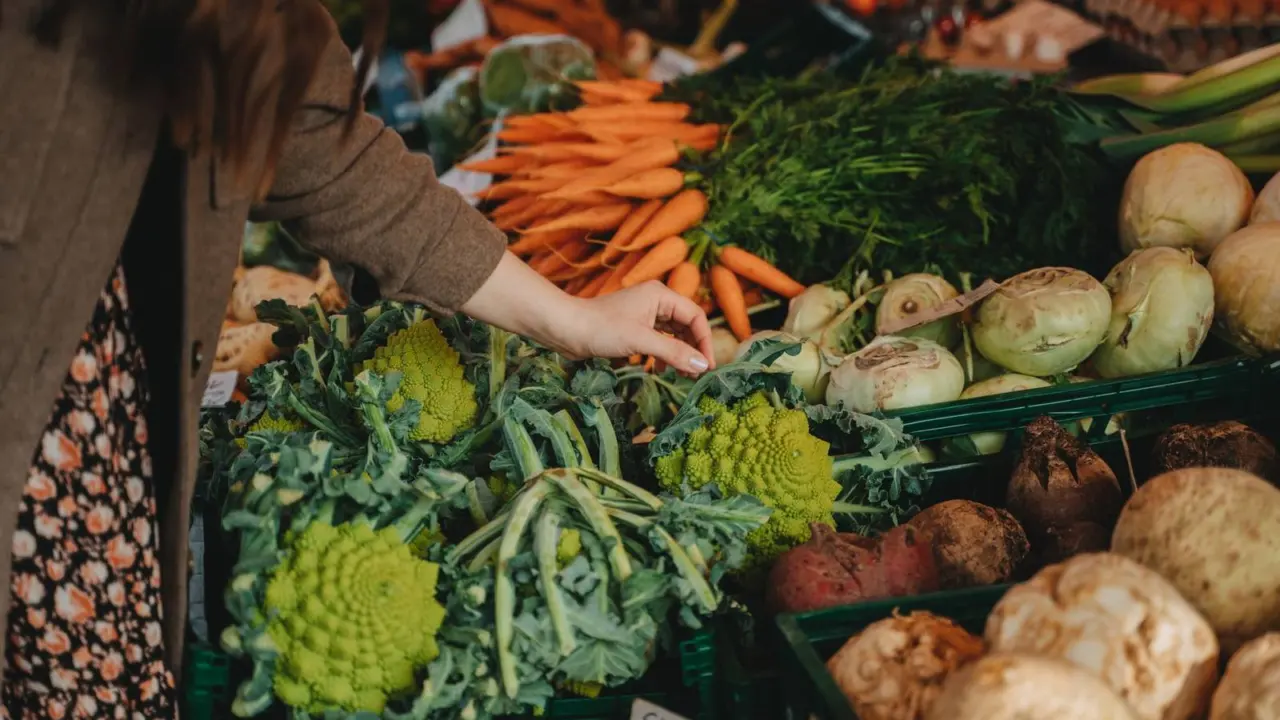
If you are asking how do farmers markets benefit communities, the short answer is that they keep money local, back small farms and bring neighbors together. Here is what the evidence shows.
This guide sits within our wider look at local businesses and community.
| Item | Value |
|---|---|
| Market customers who also shop at nearby businesses | 49% |
| Market customers who eat at nearby restaurants | 42% |
| SNAP benefits redeemed at farmers markets in 2020 | $33 million |
| Households shopping at an average US farmers market on an average day | 916 households |
| Spending at an average US farmers market on an average day | $14,547 |
| US farmers markets in 2019 | 8,140 |
The figures come from the Food Literacy Center’s April 2025 summary of a national survey and the Texas Comptroller’s June 2022 Fiscal Notes. Figures can change, so check the sources before you rely on them.
How farmers markets benefit communities through local spending
A single market stall looks small, but the spending adds up. The Texas Comptroller’s June 2022 Fiscal Notes reports that, according to a USDA report, on an average day 916 households shopped at each U.S. farmers market and spent $14,547. Those are averages, so a small weekly market in your town may see far less, and a large city market far more.
The money also travels beyond the stall. The same Texas report notes that smaller farm operations tended to purchase their supplies locally, which keeps dollars within the community. The Food Literacy Center adds that vendors and farmers report earning higher profit margins by selling directly to customers through markets.
If you want to see why a dollar that stays nearby matters, read about the local economy multiplier effect. It explains how local spending can circulate again before it leaves town.
Crowds are part of the story too. Tyler Horne, who directs the Urban Harvest farmers market in Houston, told the Texas Comptroller’s Fiscal Notes that on a typical Saturday the market has 3,000+ shoppers, and that other local businesses definitely benefit. The pattern matters more than any single total: shoppers, farmers and neighboring businesses all share in the same busy morning.
Foot traffic for the shops and restaurants next door
A market is rarely a one-stop trip. Bret Shaw of UW-Madison, a co-author of a national attendance study, said that people who attend markets often visit nearby restaurants and retail stores, according to the Food Literacy Center’s April 2025 summary.
The numbers behind that statement are clear. About 49% of market customers will shop at nearby businesses, while 42% will eat at nearby restaurants. The same summary says 80% of Americans visit a farmers market annually.
Market organizers see the effect from the inside. Laura McDonald, executive director of Texas Farmers Market, said the markets drive huge amounts of foot traffic to neighboring businesses, and that location partners see the market as an integral part of their success, as quoted in the Texas Comptroller’s report.
Support for small and beginning farmers
Markets give small producers a place to sell directly. A 2017 survey by the National Young Farmers Coalition, cited in the Texas Comptroller’s Fiscal Notes, found that farmers over 65 outnumbered farmers under 35 by six to one. The survey noted that markets are an important outlet for younger farmers, who may already face obstacles such as land access and student-loan debt.
Among the young-farmer respondents, farmers markets accounted for the second-highest share of farm sales at 18 percent. Only direct sales to customers who pay upfront for produce ranked higher, at 19 percent, according to the same Texas report.
The number of places to sell has grown a lot. These are the figures the sources give:
- The Texas report says USDA-recorded markets rose 364 percent, from 1,755 in 1994 to 8,140 in 2019 (Texas Comptroller, June 2022).
- A July 2026 news item says USDA data show more than 8,600 markets operating across the country (The Farm).
The two counts come from different reports and dates, so treat them as a trend rather than a precise like-for-like comparison.
Neighbors who show up for each other
Markets also build something harder to count. A University of Wisconsin-Madison study, published in Information, Communication & Society and covered by The Farm in July 2026, surveyed more than 5,000 adults across the United States. It found that people who regularly attend farmers markets report higher community participation and a stronger sense of belonging than those who rarely or never attend.
Community participation in the study included volunteering, interacting with neighbors and getting involved in local organizations. People who never visited markets scored lowest on community participation and neighborhood connection, according to the same coverage.
Lead author Cheryl Shea said that, in both groups the researchers looked at, the face-to-face element seems to matter. That fits what a market is: a place where you meet the person who grew your food, and probably a neighbor too.
One caution: the study describes an association. It does not prove that market visits alone cause people to become more engaged.
Food access and health
Markets can also widen who gets fresh food. The Food Literacy Center says markets help facilitate the SNAP program by making it easier for farmers to accept SNAP benefits through market managers. In 2020, $33 million in SNAP benefits was redeemed at farmers markets.
The same summary reports that 75% of market attendees say they eat healthier because of the market. That is a self-reported result from a survey, so read it as how shoppers see their own habits.
How can you get more from your local market?
You do not need to spend much to make a market work for your community. A few habits help, and each one is within reach on an ordinary weekend.
- Go regularly, because the community study linked frequent attendance with stronger participation and belonging.
- Spend a little time at the shops and cafés around the market, since that is where the nearby-business benefit shows up.
- Ask vendors about what they grow and where else they sell. Face-to-face conversation is part of the value.
- Bring friends or neighbors who have not been before.
Markets are one way in, and many independent shops sit just beyond them. Our guide on how to find local small businesses can help you keep exploring.
Frequently asked questions
Do farmers markets really help the local economy?
Show answer
The sources point that way. The Texas Comptroller’s June 2022 Fiscal Notes says businesses near markets benefited from proximity, and the Food Literacy Center reports that 49% of customers shop at nearby businesses.
Does going to a farmers market make people more involved in their community?
Show answer
People who attend often report higher community participation, according to the University of Wisconsin-Madison study covered by The Farm. The finding is an association, not proof of cause.
Can you use SNAP benefits at a farmers market?
Show answer
Many markets help vendors accept them. The Food Literacy Center notes that $33 million in SNAP benefits was redeemed at farmers markets in 2020. Ask your local market manager how it works at your market.
Are all farmers markets run the same way?
Show answer
No. The Texas Comptroller’s report says the two Texas markets it profiles are independent nonprofits, which is not the case for all farmers markets.