
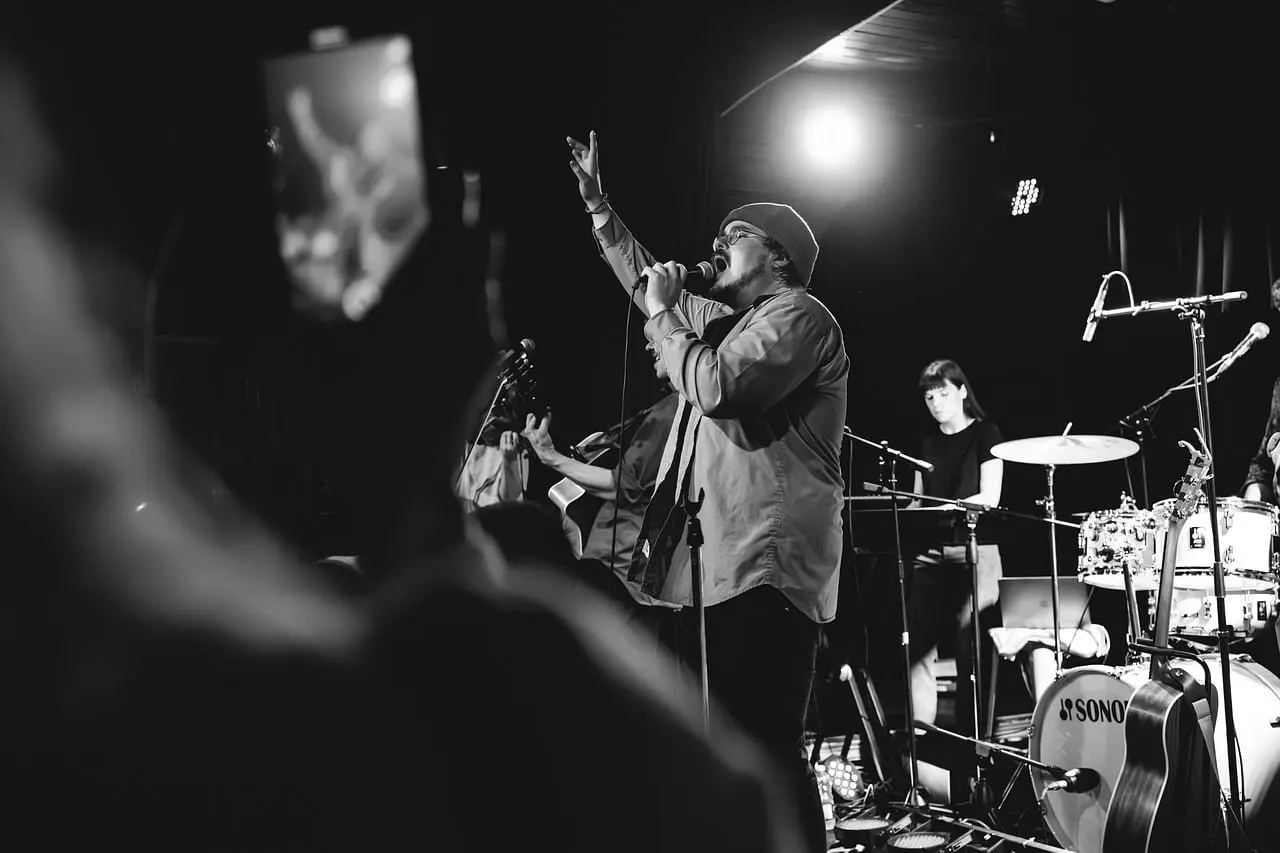
A packed Friday show can still leave the owner short. How do small music venues make money? Through bar and food sales, ticketing and room rental, each set against overhead that is due whether or not the room fills.
The wider question of how do music venues make money spans the whole local scene. This guide stays inside one small room on one night, with income on one side and costs on the other. It leaves out what performers are paid. Booking is covered in how do music venues book local bands, and the split of door money is covered in door deal vs guarantee for bands.
Why a full room is not the same as a profitable night
An independent music venue sells more than admission. It sells an evening in a room, and the ticket is only the first entry in the night’s ledger. The National Independent Venue Association (NIVA) reported in 2025 that 64% of independent stages are struggling with unprofitability. It also reported that 88% face ongoing financial pressure. Crowds do not guarantee a surplus, because the money coming in has to cover a long list of costs that do not shrink on a quiet week.

Several assumptions about venue finances do not hold up against that evidence. The table sets the common ones beside what the evidence supports.
| Common assumption | What the evidence shows | Planning use |
|---|---|---|
| A sold-out show means the venue is doing well | 64% of independent stages are struggling with unprofitability | Treat attendance as one input, not proof of health |
| Ticket sales pay for the night | Venues also offer food and beverages alongside concerts, so the counter is a second income line | Look at the bar and food menu when judging a room’s income |
| A small room runs like a scaled-down arena | Small venues are more financially vulnerable than large concert arenas | Expect less cushion when a night goes badly |
| Shows are the only way a room earns | Some venues operate as multi-use spaces, for example hosting church services as well as concerts | Rentals and other uses can fill days without a show |
The pressure figures come from NIVA’s 2025 statement, and the vulnerability and multi-use points come from Main Street Crossing’s account of small venues.
Income lines on show night
Three lines carry most of the income side of a small venue’s ledger: the bar and kitchen, the ticket, and the room itself. They behave differently, and a venue’s business model is the particular mix of the three it can sustain.
Bar and food sales
Beverages and food sit alongside the music at venues such as Main Street Crossing, which offers food, beverages and community seating at its concerts. The counter works differently from the door. A ticket is bought once per person, while the bar stays open through the whole evening, so it earns from time spent in the room. That makes bar sales the line most tied to how comfortable and lively the room feels, not just to who is on stage.
The bar also has a cost side. Stock is bought before it is sold, and unsold inventory is money already spent. A venue that books acts drawing people who stay and order is earning in a way a ticket price alone cannot match. A night that fills the room with people who only buy a ticket and leave early earns less at the counter.
Ticketing and cover
Ticket income is limited by how many people the room holds and by what the neighbourhood will pay. Intimacy is part of what the ticket buys. Main Street Crossing, a nonprofit venue, notes that its furthest seat is only 45 feet from the stage, which is the kind of closeness an arena cannot offer. For a small room, a sold-out show is therefore a ceiling rather than a growth path. It can only raise income by pricing, by keeping the bar busy, or by adding more nights.
Taxes on tickets can also reduce what a venue keeps. NIVA’s 2025 statement points to a proposed Illinois amusement tax of 7% in SB 2111, which would apply to live performance and concert tickets for venues of 1,500+ capacity. That threshold is far above a small room, but it shows how ticket revenue can come with a levy attached. Anyone running or supporting a small venue should watch for similar proposals at lower thresholds.

Room rental and other uses
Private event rental turns empty weekday hours into income. Main Street Crossing functions as a multi-use venue for church services, concerts and more, so the same space earns whether or not a band is playing. For an owner, this is the line that smooths the calendar. Show income is lumpy and depends on who is touring, while a rental booking does not rely on a headliner. Its limit is the calendar itself, because every rented slot is a night the stage is not available for a show.
Overhead: what comes out before anything is kept
Overhead is the set of costs a venue carries whether or not a show happens. It is the reason a good night does not translate directly into profit, and it is where small venues differ most from larger operators. The supported pieces of the cost side are these.

- Debt and personal liability. Independent owners often take out lines of credit that they can be personally liable for, according to Main Street Crossing. A venue’s financing is therefore the owner’s own exposure, not just a business line.
- Loan payments in a bad stretch. When closures or limited capacity cut income, it can be difficult to make those payments. The loan terms stay the same while the revenue shrinks.
- Ticket taxes. Proposals such as the Illinois amusement tax show that a levy can be attached to the ticket line described earlier.
- Running costs of the room. Rent or mortgage, licensing, staffing and bar stock make up the rest of the ledger. They are the costs that keep arriving on quiet weeks, and they explain why venue owners lean on the bar and rentals.

Why margins stay thin
Thin margins follow from combining modest capacity with obligations that do not flex. A room that holds a limited crowd has a ceiling on ticket and bar income. Debt and fixed costs sit underneath that ceiling. The more of the ledger that is fixed, the less a single strong night can change the picture, and the more a single weak stretch hurts.
The scale of the problem is documented. NIVA’s 2025 reporting says 64% of independent stages struggle with unprofitability, and 88% face ongoing financial pressure. The same statement says independent stages generate $153.1 billion in economic investment across the U.S. The gap between those two facts is the practical point. The rooms contribute widely to their communities, yet most of them operate with little financial room for error.
What this means for fans and local acts
A venue’s income is spread across several lines, so support is spread across several actions as well. Buying a ticket funds the door line. Staying for a drink or food funds the line that earns most per hour spent in the room. Booking a private event funds the calendar gaps. None of these replaces the others, and a venue leaning on only one of them is more exposed when that line weakens.
Local acts benefit from understanding the same ledger. A room that has to cover debt and fixed costs from limited capacity will think about a night’s bar potential as well as its ticket draw. Why that matters for the conversation with a booker is explained in the booking guide linked above.
Frequently asked questions
| Question | Answer |
|---|---|
| What are a small venue’s biggest costs? | The supported pressure points are debt that owners are often personally liable for and any tax attached to tickets. Alongside them sit the fixed costs of running the room, which continue on nights with no show. |
| Why do venues often run on thin margins? | Capacity limits ticket and bar income while debt and other obligations stay fixed. NIVA reports that 64% of independent stages are struggling with unprofitability. |
| What other income do venues have besides shows? | Food and beverage sales at events, and rental of the space for other uses. One nonprofit venue operates as a multi-use space for church services as well as concerts. |
| Are small venues riskier than arenas? | Yes. Main Street Crossing describes small venues as more financially vulnerable than large concert arenas, partly because owners take on personal credit liability. |